by Chuck Seaver, South Lake Tablet
Clermont has long been known for its hospitality and community events, but one such event in August of 1967 brings reflection to a time when the townspeople rolled up their sleeves and depended more on civic-service teamwork than local government-based creativity.

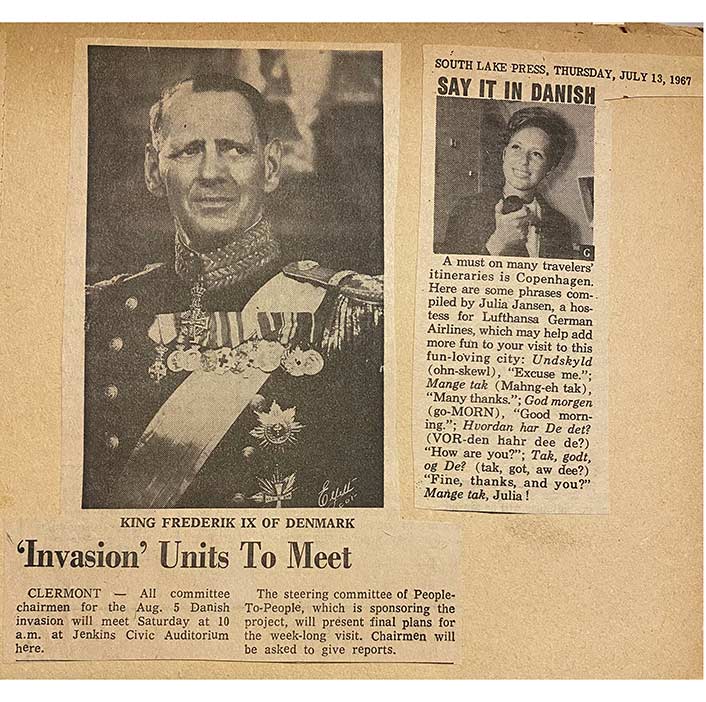 One of the most exciting events in Clermont’s history, at the time, was the six-day “Danish Invasion.” With unanimous approval, and under the guidance of Mayor Joseph Bon Jorn, the Clermont City Council proclaimed the week of August 6-12, 1967, as “Clermont-Denmark Friendship Week.”
Committees were formed by community members, and work quickly began to welcome the 150 visiting citizens of Denmark to the city of Clermont. The idea was born from local community leaders James Grant and Fred Wolfe. James was the son of pharmacy owner Russell Grant, who co-owned a pharmacy in the location of the present-day Yummi’s Frozen Yogurt, 650 Eighth Street, Clermont. Fred Wolfe was a prominent businessman in Clermont who founded the Clermont Builders Supply located at 1000 Carroll Street, Clermont, and is the current site of retail and residential development.
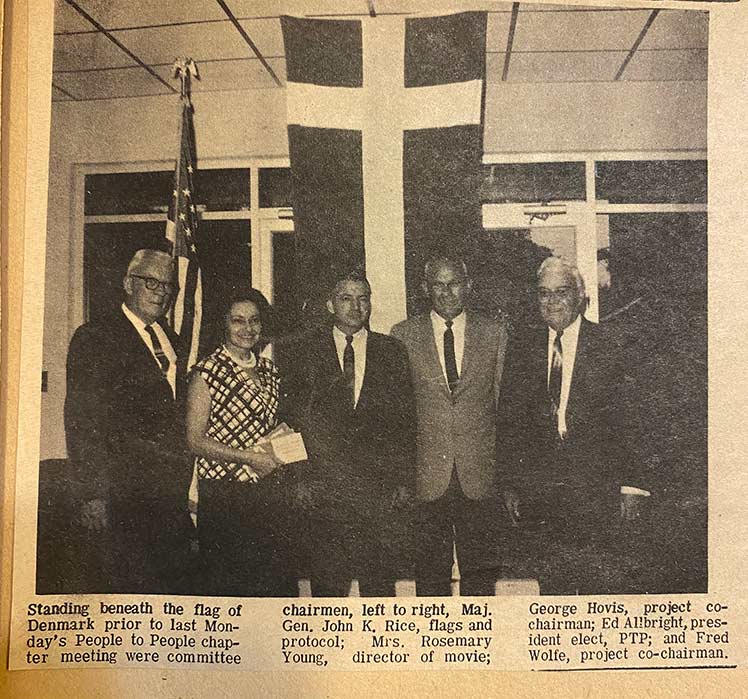
Fifty-one homes in Clermont would host the Danes, many with three visitors. Local women would make hundreds of Danish flags in three different sizes. Large flags lined downtown when the Danes’ four Greyhound buses pulled in front of Jenkins Auditorium on West Montrose Street at Seventh Street in downtown.
Eleanor Cashwell, the librarian at Cooper Memorial Library, located at the time on West Desoto Street in the vicinity of the current Clermont City Hall parking lot, reported that a special display of materials about Denmark had been placed on exhibit in the library to help with the preparation for the Danish visitors coming to Clermont. The display is reported to have included beautifully illustrated books, articles about Denmark from the National Geographic Magazine, as well as from Holiday, Time, Saturday Review, and Atlantic Magazine. Posters, folders, and pamphlets were donated by the Landseair Travel Service. Landseair was located in a stand-alone building at the southeast corner of Minneola Avenue and Eighth Street, the current site of the City of Clermont’s Bell Tower.
The People-to-People (PTP) organization, a program established on September 11, 1956, by President Dwight D. Eisenhower, as part of the United States Information Agency, had a local chapter in Clermont that was active and was a large part of coordinating the entertainment for the Danish visitors. Part of the entertainment included the making of a “in color” movie for international usage of all activities. The film would be used by the headquarters of PTP to show foreign countries and in the Clermont Chamber of Commerce, presently known as the South Lake Chamber of Commerce.
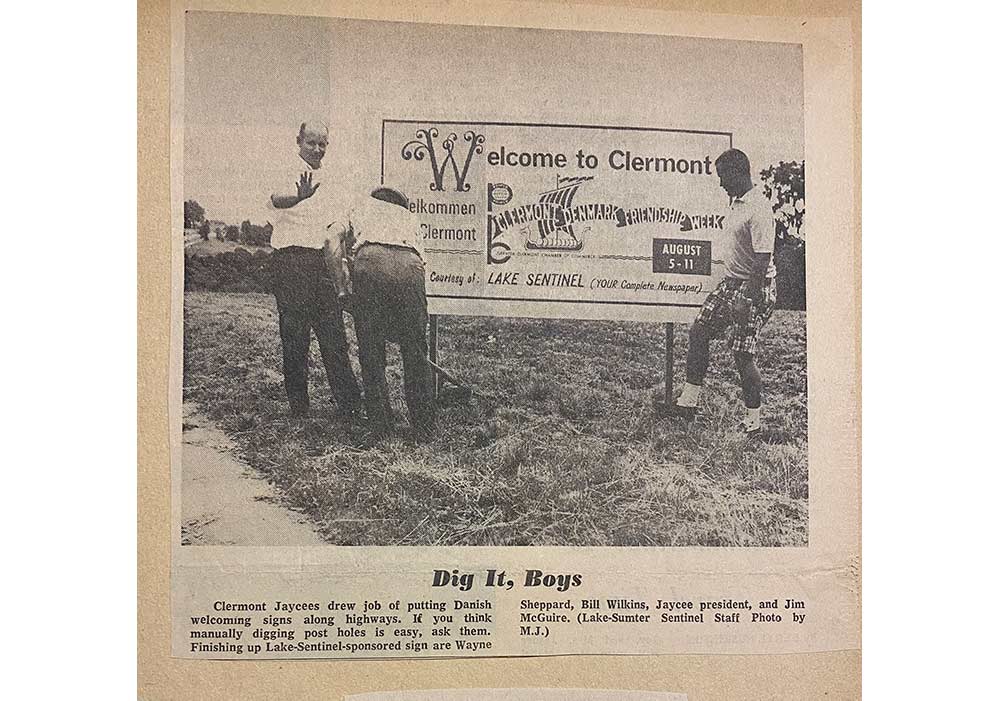
On August 5, 1967, hundreds of townspeople lined the streets in downtown Clermont, waving small Danish flags and cheering for the arriving visitors. Many of the visitors were reported to have been in tears when they saw the warm welcome and friendly smiles of the welcoming crowd. Twenty signs proclaiming “Clermont-Denmark Friendship Week” were strategically placed along highways. The Clermont Jaycees, a civic organization that gave Waterfront Park its original name of Jaycee Beach, was responsible for erecting the signs.
Each day and night of the week-long visit was packed with events, including some out-of-town. The Orlando Sentinel newspaper hosted a dinner for all the Danes and their hosts, complete with a tour of the plant facilities after dinner. Cypress Gardens entertained the guests for half a day, all expenses paid. The Florida Game and Freshwater Fish Commission wardens spent a day giving airboat rides through local marshes and waterways. After a day on the beautiful chain of lakes, the visitors were treated to a trip atop the Citrus Tower. At the time, a view from the magnificent tower revealed miles and miles of deep green citrus trees strategically placed in flowing rows nestled on and around Clermont’s “Gem-of-the-Hills.”
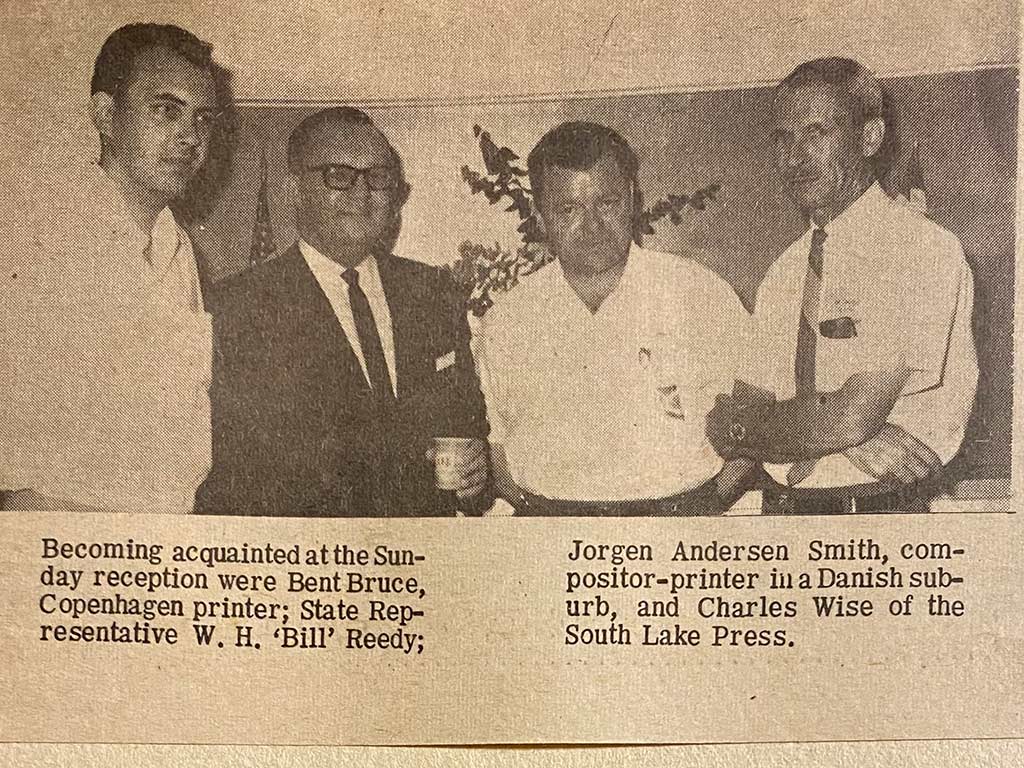
Several organizations and businesses provided breakfast and supper socials for the visitors and anyone else who wanted to attend. Barbeques, pancake breakfasts, fish fries, and southern, menu-style meals were provided by the Clermont-Groveland Elks Club, the Kiwanis Club of Clermont, Florida Power Corporation, the Clermont Woman’s Club, and several area churches.
Friendships developed that lasted a lifetime for many of the visitors and area residents. Local folklore includes a story of an eventual marriage between a visiting young Dane man and a local young lady, but that piece of romance could not be confirmed at the time of this story. Many of the hosts later visited Copenhagen.
At the August 8th city council meeting, during the week of the “Danish Invasion,” Clermont City Manager Albert Johnson proclaimed that the city of Clermont’s population grew by 150 honorary citizens. Mayor Bon Jorn introduced a resolution recognizing each of the visitors as an honorary citizen of Clermont. The resolution, unanimously passed by the city council, was presented to the visitors as they boarded the bus for departure on August 11th. Upon departure, the guests travelled to Brevard County for a tour of NASA- Cape Kennedy, then on to Washington, D.C., and finally to New York and home to Denmark.
(Photo and story details are courtesy of the archives from the South Lake Chamber of Commerce, Cooper Memorial Library, Clermont Historic Village Museum, the former South Lake Press, and the books Clermont-Gem of the Hills and Clermont-A History of Clermont, Florida)
Visit www.ClermontHistoricVillage.org for a wide range of Clermont and South Lake County history.